
Almost everything written about Ayurvedic hair oil is written by someone selling it. This guide is not. Nothing here is affiliated with a brand, and where the evidence is thin, it says so.
Hair oiling is one of the oldest continuous personal-care practices on earth. It is also one of the most oversold. Both things are true, and the useful version of this subject sits between "ancient miracle" and "just grease."
What Ayurvedic hair oil actually is
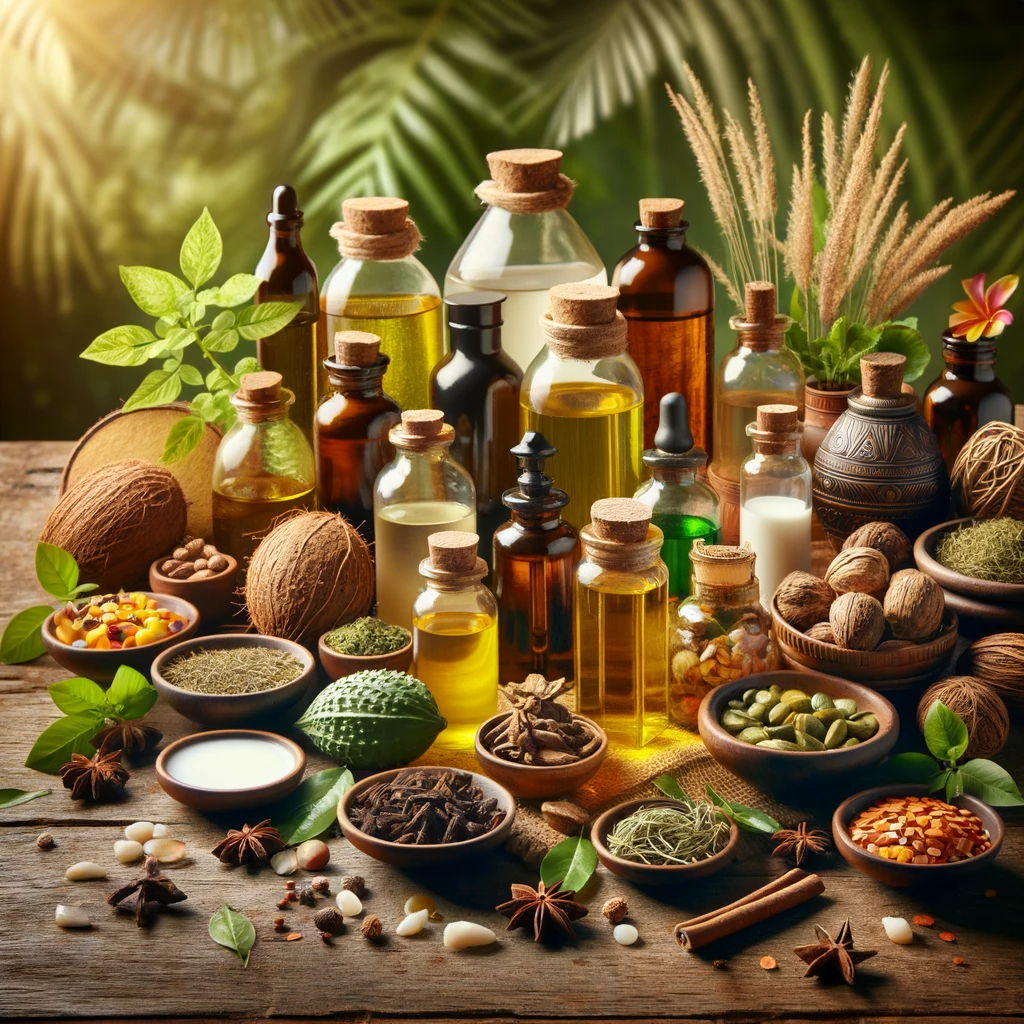
An Ayurvedic hair oil is a carrier oil that has been infused with herbs, not an essential oil and not a blend of fragrance oils. The traditional method, taila paka, simmers herb material - fresh juice, paste, or decoction - into a base oil until all the water has cooked off. What is left is an oil carrying the fat-soluble constituents of the plants.
This matters when you read a label. A product listing "coconut oil, fragrance, bhringraj extract" near the bottom is a scented coconut oil. A genuine preparation lists a small number of herbs prominently, and the oil is usually dark, cloudy, and strong-smelling. Clear, pale, pleasant-smelling hair oil is generally a cosmetic product wearing Ayurvedic language.
The practice is scalp care first and hair care second. In Ayurveda, hair is a by-product of tissue metabolism rather than a thing you treat directly, so the oil goes on the scalp. Coating the lengths does something useful too - reducing protein loss during washing - but that is a different mechanism.
The herbs that matter
Four herbs make up the bulk of real formulations. The rest is mostly variation.
Bhringraj
Bhringraj (Eclipta prostrata, often labelled Eclipta alba) is the specific hair herb. Its Sanskrit name means "king of hair", classical texts group it under keshya herbs that act on hair directly, and it is the dominant ingredient in most traditional formulas.
It is also the best-studied. Two animal studies found topical extracts accelerated hair growth in rodents, one of them outperforming 2% minoxidil in that model. Both were rodent studies. No randomised controlled trial in humans has been published. That is a genuinely encouraging preclinical result and it is not the same as proof that it works on your head.
Amla
Amla (Indian gooseberry) is the second most common, usually paired with bhringraj for premature greying. It is exceptionally high in vitamin C and polyphenols, and the plausible mechanism for hair is antioxidant activity at the follicle plus iron chelation reducing scalp oxidative stress. Amla is the most food-like herb here and the least likely to cause anyone trouble.
Brahmi
Brahmi is better known as a cognitive herb, and its inclusion in hair oils is partly about the scalp massage being calming rather than the herb acting on follicles. That is not a criticism - stress is a real contributor to shedding - but be clear about which claim is being made.
Neem
Neem earns its place through antimicrobial and antifungal activity, which is why it appears in oils aimed at flaking and itching rather than growth. Dandruff is substantially a yeast problem (Malassezia), so an antifungal ingredient is mechanistically sensible. Neem is bitter, strong-smelling, and usually a minority ingredient.
Fenugreek, hibiscus, and tulsi appear regularly too. Worth knowing that fenugreek for hair has essentially no human trial evidence - the research is animal and in vitro only - despite how confidently it gets marketed. Hibiscus is on slightly firmer ground, with one frequently cited animal study behind it, and it is a classical keshya herb where fenugreek is a household practice.
Carrier oils, and why the base matters more than people think
The carrier is most of the bottle, so it is most of what your scalp gets.
Coconut oil is the one with the strongest evidence behind it, and the evidence is not about growth. Coconut oil has an unusual ability to penetrate the hair shaft and reduce protein loss during washing, which is why it works as a pre-wash treatment. It is cooling in Ayurvedic terms, which suits Pitta and hot weather. It solidifies below about 24°C, which is a practical nuisance in a cold house.
Sesame oil is the classical default and the traditional base for most medicated oils. It is warming, which suits Vata and cold dry weather. Heavier and stronger-smelling than coconut.
Almond oil is light, neutral, and a reasonable choice for fine hair that gets weighed down.
Jojoba is technically a wax ester rather than an oil, and its structure is close to human sebum. It is the least greasy option and the easiest to wash out, which makes it a sensible pick for anyone whose scalp gets congested easily.
If you are choosing on climate rather than dosha: coconut in heat, sesame in cold.
How to actually use it
This is the part most articles skip, and it is the part that decides whether you get anything out of it.
- Warm the oil. Not hot - stand the bottle in warm water for a minute. Warm oil spreads further and is more pleasant, and it matters more with heavier bases.
- Part the hair and apply to the scalp, not the lengths. Use fingertips, work in sections, and use less than you think. A tablespoon is plenty for most heads.
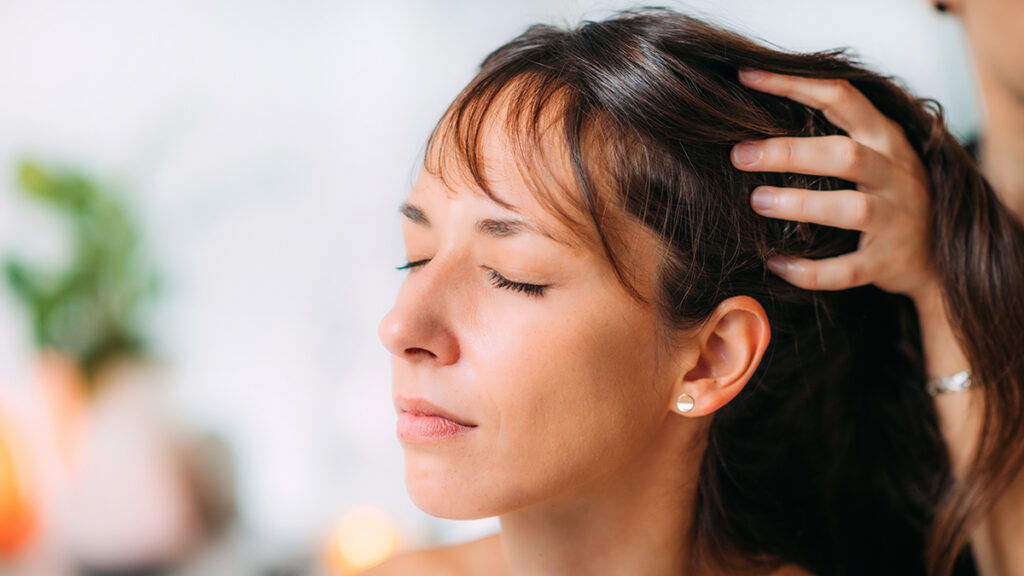
- Massage for five to ten minutes. Fingertips, not nails, with firm circular pressure. This is shiro abhyanga, and the massage is not incidental - it is arguably the more reliable part of the practice.
- Leave it in. Thirty minutes is enough for the shaft-penetration effect. Overnight is traditional but not required, and if you have a congestion-prone scalp, overnight can make flaking worse.
- Wash it out properly. Shampoo before wetting the hair, or the oil repels the water. Expect two rounds.
Twice a week is a sensible rhythm. Daily oiling is not more effective and for some scalps is actively counterproductive.
Who should be cautious
Anyone with seborrhoeic dermatitis, active fungal scalp conditions, or a scalp that flakes more after oiling should treat this practice carefully. Malassezia feeds on lipids, and adding oil can feed the problem. If oiling consistently makes your scalp worse, that is information - stop, rather than pushing through.
What the evidence supports, honestly
Three separate claims get bundled together, and they sit at very different levels of confidence.
Reducing breakage and protein loss: well supported. Coconut oil in particular has been shown to reduce protein loss in hair when used before washing. This is a real, measurable, mechanically understood effect. If your hair looks better after months of oiling, this is the likeliest reason.
Scalp comfort - flaking, itching: reasonably supported. Antimicrobial herbs plus a moisturised scalp plus massage is a plausible and low-risk combination. Not a treatment for a diagnosed scalp condition.
Regrowing lost hair: not supported in humans. The bhringraj rodent studies are encouraging and the phytochemistry is interesting, but no human trial establishes that any Ayurvedic hair oil regrows hair. Anyone telling you otherwise is going beyond the evidence.
There is one more mechanism worth naming: massage itself. Scalp massage has some evidence for increasing hair thickness through mechanical stimulation of the follicle, independent of what you massage with. Some of what people attribute to the oil probably belongs to the five minutes of pressure.
The one oil with better human evidence is not Ayurvedic
If you are here because you want the best-evidenced botanical option for hair growth, honesty requires pointing somewhere else: rosemary oil.
Panahi and colleagues (2015) randomised 100 people with androgenetic alopecia to either rosemary oil or 2% minoxidil for six months. Neither group had changed significantly at three months. At six months both had increased hair count, with no significant difference between them, and the rosemary group reported less scalp itching.
That is a stronger result than anything in the Ayurvedic hair literature, because it is a human trial rather than a rodent one. It also needs its caveats stated: it is a single trial of 100 people, it compared against minoxidil 2% rather than the 5% most people use, and there was no placebo arm - both groups received an active treatment, so "both improved" cannot fully separate the treatments from ordinary variation. Minoxidil itself has decades of controlled data behind it and rosemary does not.
Rosemary is not an Ayurvedic herb, and it is not part of the taila paka tradition. It is mentioned here because this guide is not selling Ayurvedic oil, and a reader whose actual goal is regrowth deserves to know where the better evidence sits. Rosemary oil is an essential oil, so it must be diluted in a carrier before it goes anywhere near your scalp - and it can be added to a bhringraj or amla oil rather than replacing it.
When to see a doctor instead
Hair loss has medical causes that no oil addresses. Sudden shedding, patches, a widening part, or loss alongside fatigue, weight change, or scalp pain warrants proper assessment. Thyroid disease, iron deficiency, androgenetic alopecia, and autoimmune conditions all present as hair loss, and all of them have real treatments. Oiling is not a reason to delay finding out.
Choosing a product without getting caught
- Read the ingredient order. Herbs should be near the top. If fragrance outranks the herbs, it is a scented oil.
- Avoid mineral oil and liquid paraffin as the base. They sit on the surface and do not penetrate the shaft, which loses you the one well-evidenced benefit.
- Dark and smelly is a good sign. Genuine herb-infused oil is not pretty.
- Ignore "clinically proven" unless a study is named. It usually means a consumer perception survey.
- Match the base to your climate, not to the marketing.
- Patch test. Behind the ear, 24 hours, before you put a new oil on your whole scalp.
Making your own
Simmer roughly one part dried herb to four parts oil on the lowest possible heat for two to three hours, until any moisture has cooked off and the herb material is crisp rather than soft. Strain thoroughly - residual plant matter and water will spoil the oil. Store dark and cool, and expect a few months of shelf life rather than years, since home preparations have no preservative system.
Frequently asked questions
How long before I see a difference? Hair grows about a centimetre a month, so any honest answer is three to four months of consistent use. Breakage improvements can show sooner because that is about condition, not growth.
Can I use it on coloured hair? Yes, though oiling before washing can accelerate colour fade, and bhringraj-heavy oils are dark enough to tint light or grey hair over time. Patch test on a hidden section.
Do I have to leave it overnight? No. Thirty minutes captures most of the benefit. Overnight is tradition rather than a requirement, and it is a poor idea if your scalp gets congested.
Is it safe during pregnancy? Topical use of a simple herb-infused oil is generally low risk, but check the ingredient list for essential oils, several of which are not recommended in pregnancy. Ask your midwife or doctor.
Will it stop hair loss? It has not been shown to in humans. It may support scalp condition and reduce breakage, which can make hair look fuller. If you are actively losing hair, get the cause diagnosed.
Coconut or sesame? Coconut in heat and for shaft protection; sesame in cold weather and for the classical preparations. If you have no idea, start with coconut.
Where to go next
Read the individual herb profiles for bhringraj, amla, brahmi, neem, hibiscus, and fenugreek before buying anything. Understanding your constitution helps you pick a base oil, and dinacharya puts the practice into a daily rhythm rather than treating it as an occasional fix.
The short version: buy a simple oil with herbs high in the list, put it on your scalp twice a week, massage properly, and give it four months. That is most of the value, and it costs very little to test.
Sources
- Roy RK, Thakur M, Dixit VK (2008). "Hair growth promoting activity of Eclipta alba in male albino rats." Archives of Dermatological Research 300(7): 357–364. doi:10.1007/s00403-008-0860-3
- Datta K, Singh AT, Mukherjee A, Bhat B, Ramesh B, Burman AC (2009). "Eclipta alba extract with potential for hair growth promoting activity." Journal of Ethnopharmacology 124(3): 450–456. doi:10.1016/j.jep.2009.05.023
- Panahi Y, Taghizadeh M, Marzony ET, Sahebkar A (2015). "Rosemary oil vs minoxidil 2% for the treatment of androgenetic alopecia: a randomized comparative trial." SKINmed 13(1): 15–21. PMID 25842469
Studies 1 and 2 are animal models. Study 3 is a human trial without a placebo arm.